
The Texas Hill Country corridor between Austin and San Antonio remains one of the most dynamic residential construction markets in the state. From the rapidly expanding communities around Kyle and Buda to New Braunfels, Canyon Lake, Bulverde, and Spring Branch, demand for new homes continues to shape the region’s landscape.
But the market of 2026 is very different from the extraordinary boom experienced during the pandemic years.
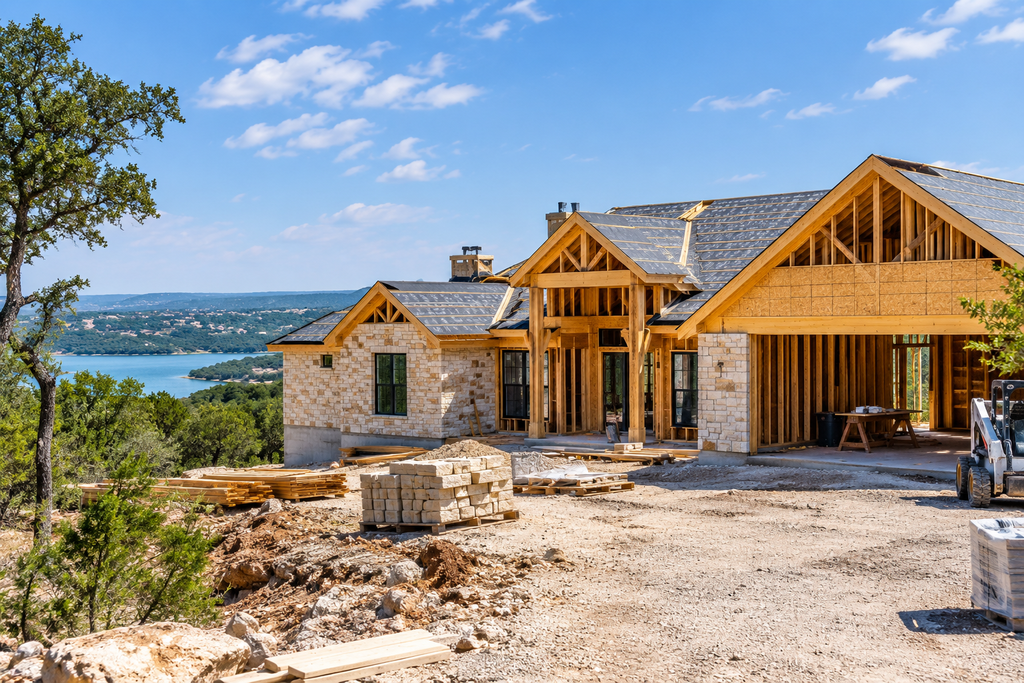
Today’s buyers are more selective. Interest rates remain elevated, construction costs continue to influence home prices, and builders are competing more aggressively for buyers. At the same time, Central Texas continues to benefit from population growth, economic expansion, infrastructure investment, and the unique appeal of the Texas Hill Country.
For buyers considering a new home, the current environment may actually create opportunities that were difficult to find just a few years ago.
A Market That Has Shifted From Frenzy to Balance
The Central Texas housing market has spent the past several years transitioning from an exceptionally competitive seller’s market toward a more balanced environment.
According to Unlock MLS, the Austin-Round Rock-San Marcos metropolitan area recorded 15,698 closed residential sales during the first half of 2026, an increase of 4.8% from the same period in 2025. Pending sales were up 9.8%, while the median price declined 2.4% to $425,000. Active inventory also declined compared with the previous year.
These numbers tell an important story: buyers are returning to the market, but they are not necessarily willing to pay whatever sellers are asking.
That distinction is particularly important for new construction.
During the housing boom, builders could sell homes quickly, raise prices between releases, and maintain relatively limited incentives. In today’s market, buyers have more choices and more negotiating power.
Builders have responded by offering incentives, adjusting floor plans, controlling construction starts more carefully, and placing greater emphasis on affordability.
The Texas Real Estate Research Center at Texas A&M has identified the same trend statewide. New construction has increasingly moved toward lower price points as builders respond to high mortgage rates, elevated home prices, and affordability concerns. By March 2026, the median price of a new home in Texas was approximately $341,500 compared with $326,200 for an existing home—a gap of about $15,500.
That is a dramatic change from the years before the pandemic, when new homes frequently carried substantially larger premiums over existing homes.
The Austin-to-San Antonio Corridor Continues to Grow
One of the strongest fundamentals supporting the Texas Hill Country housing market is the continued development of the Austin-San Antonio corridor.
Communities such as Kyle, Buda, San Marcos, New Braunfels, and Schertz are increasingly functioning as independent economic centers rather than simply bedroom communities for Austin or San Antonio.
Commercial development is following residential growth.
Major projects along the I-35 corridor are adding retail, restaurants, employment opportunities, entertainment, and housing. New Braunfels, San Marcos, Kyle, and Schertz are seeing significant commercial investment, further increasing the attractiveness of these communities to families and businesses.
This matters to the new-home construction market because people generally want more than a house. They want access to employment, shopping, schools, healthcare, recreation, restaurants, and entertainment.
The communities between Austin and San Antonio increasingly provide all of those things.
New Braunfels Has Become a Major Housing Market
New Braunfels occupies a unique position in the corridor.
Located approximately halfway between Austin and San Antonio, the city offers access to two major metropolitan areas while retaining many of the characteristics that have historically attracted people to the Texas Hill Country.
The Guadalupe and Comal Rivers, Canyon Lake, Gruene, Schlitterbahn, historic downtown, and surrounding Hill Country have made the area a major tourism destination. That tourism economy has also helped drive residential growth.
Today, New Braunfels is no longer simply a small Hill Country town experiencing occasional growth. It has become a major residential market with extensive new-home construction, master-planned communities, commercial development, and infrastructure investment.
For builders, however, New Braunfels presents two very different markets.
On one side are production communities offering relatively standardized homes at increasingly competitive prices. On the other are buyers looking for larger lots, customized floor plans, higher-end finishes, acreage, Hill Country views, and homes designed specifically for their property.
That second category creates an ongoing opportunity for custom home builders.
The Custom Home Market Is Different From Production Construction
The state of the new-home market cannot be evaluated solely by looking at production housing.
A buyer purchasing a $350,000 home in a master-planned community has very different motivations from someone purchasing five or ten acres near Canyon Lake and building a custom home.
Custom-home buyers are often less sensitive to small changes in mortgage rates because they are making a much longer-term decision. They are also more concerned with lot characteristics, architectural design, construction quality, energy efficiency, outdoor living spaces, views, garages, workshops, pools, guest accommodations, and the overall relationship between the home and the land.
This is particularly true throughout the Hill Country.
Land is one of the defining characteristics of the region, and many buyers are attracted to Central Texas precisely because they do not want a traditional subdivision lot.
Communities around Canyon Lake, Bulverde, Spring Branch, Wimberley, Blanco County, Comal County, and the rural areas north of San Antonio continue to appeal to buyers seeking more space and privacy.
Canyon Lake and the Hill Country Acreage Market
The Canyon Lake area represents one of the clearest examples of how different the custom-home market can be from conventional residential construction.
Rather than simply purchasing a finished house, buyers may purchase a homesite and then determine what type of home makes sense for the property.
Topography becomes important.
Views become important.
Trees, rock formations, drainage, utilities, septic requirements, driveway access, setbacks, easements, and deed restrictions can all influence the design and cost of a home.
A 2,500-square-foot home on a relatively flat suburban lot is a fundamentally different construction project from a 2,500-square-foot home on a steep Hill Country property.
The latter may require significantly more planning before construction even begins.
This is why experienced custom-home builders in the Texas Hill Country increasingly function as more than construction companies. They help buyers understand the relationship between the property, the house plan, site development, engineering, utilities, and the overall construction budget.
Bulverde and Spring Branch Continue to Attract Custom Buyers
North of San Antonio, Bulverde and Spring Branch have experienced some of the most noticeable transformations in the region.
What were once predominantly rural areas with scattered custom homes have increasingly become established residential markets containing both production communities and large-lot developments.
The appeal is straightforward: buyers can remain within reasonable commuting distance of San Antonio while obtaining more land and a Hill Country environment.
The challenge is that development costs can vary considerably from property to property.
A lot may require significant clearing, rock excavation, retaining walls, extensive driveway construction, septic improvements, or specialized foundation engineering.
Consequently, buyers considering a custom home should evaluate the total cost of the project, rather than simply comparing builders by their advertised price per square foot.
Interest Rates Continue to Influence Buyer Behavior
The biggest challenge facing the broader housing market remains affordability.
As of early September 2026, the average U.S. 30-year fixed mortgage rate had climbed to approximately 6.71%, according to Freddie Mac data reported by Reuters.
That is considerably higher than the exceptionally low rates available during the pandemic.
Higher rates do not necessarily eliminate demand, but they change buyer behavior.
Buyers who might previously have stretched their budgets are more likely to:
- negotiate harder on price;
- compare multiple builders;
- seek builder incentives;
- choose a smaller floor plan;
- delay construction;
- purchase land before building;
- prioritize energy efficiency;
- or reconsider which features are truly necessary.
Builders have had to adjust accordingly.
The days when nearly every new home could be sold immediately at a rapidly increasing price are gone.
Builders Are Becoming More Competitive
For buyers, one of the most positive aspects of the current market is increased competition among builders.
Builders have fewer reasons to simply build whatever they can sell. They have to understand what buyers want and how much buyers can realistically afford.
That has resulted in greater attention to:
- energy-efficient construction;
- flexible floor plans;
- functional kitchens;
- outdoor living;
- larger garages;
- home offices;
- storage;
- aging-in-place considerations;
- smart-home technology;
- lower-maintenance materials;
- and improved insulation and mechanical systems.
In the custom-home market, transparency is becoming particularly important.
A buyer should understand not only the base construction price but also allowances, site work, architectural fees, engineering, utility connections, landscaping, driveways, patios, pools, appliances, and other potential costs.
The more transparent the process is before construction begins, the fewer surprises the buyer is likely to encounter later.
Land Is Becoming an Increasingly Important Part of the Equation
One of the biggest differences between building in the Hill Country and building in a conventional suburban development is the importance of the land itself.
A buyer can find what appears to be an affordable piece of land and then discover that the actual cost of developing the property is substantially higher.
Before purchasing land, prospective builders should investigate:
- deed restrictions and CC&Rs;
- HOA requirements;
- utility availability;
- water source;
- septic requirements;
- floodplain status;
- topography;
- soil conditions;
- driveway access;
- easements;
- setbacks;
- building envelopes;
- tree restrictions;
- masonry requirements;
- garage requirements;
- and architectural review requirements.
A property that appears inexpensive on a listing website may not necessarily be inexpensive to build on.
Conversely, a more expensive property may ultimately prove to be the better value if it has favorable topography, utilities, access, and a suitable building site.
The Market Is Becoming More Segmented
One of the most important trends in 2026 is that there is no longer one Central Texas housing market.
There are multiple markets operating simultaneously.
Entry-level and moderately priced buyers remain highly sensitive to interest rates and monthly payments. Production builders are competing aggressively in this segment.
Move-up buyers have more choices and are carefully evaluating whether a new home provides enough value to justify its price.
Higher-income and luxury buyers are operating under a different set of circumstances.
Recent reporting on the San Antonio market illustrates this divide. The higher end of the market has continued to perform considerably better than the lower end, with luxury buyers less affected by interest rates and affordability constraints.
That dynamic extends into portions of the Hill Country, where custom homes, acreage properties, and higher-end developments appeal to buyers with different financial circumstances than the typical first-time buyer.
Why the Hill Country Remains Attractive
Despite the challenges facing the housing industry, the fundamental reasons people want to live between Austin and San Antonio have not disappeared.
The region offers a combination that is difficult to replicate:
Access to major cities.
Austin and San Antonio provide two large employment and economic centers within relatively close proximity.
Hill Country lifestyle.
Rolling terrain, limestone formations, rivers, lakes, trees, and open land create an environment that is fundamentally different from many urban markets.
Economic growth.
Central Texas continues to attract businesses, investment, and residents.
Recreation and tourism.
Canyon Lake, the Guadalupe River, New Braunfels, Wimberley, and surrounding communities attract visitors from throughout Texas and the country.
Infrastructure investment.
Road improvements, utilities, retail, healthcare, schools, and commercial development are continuing to expand throughout the corridor.
Housing choices.
Buyers can choose everything from production homes in master-planned communities to highly customized homes on acreage.
That diversity is one of the area’s greatest strengths.
What Should Buyers Expect Going Forward?
The most likely direction for the new-home market is not a return to the frenzy of 2020–2022, but rather a more normal and sustainable market.
Builders are likely to remain disciplined about new projects. Higher financing and construction costs make it more expensive to carry speculative inventory, while buyers continue to demand value.
Nationally, single-family housing starts remained under pressure during the summer of 2026, with high mortgage rates and economic uncertainty discouraging some builders from significantly increasing new projects.
At the same time, Central Texas has shown signs of improving demand. Rising pending sales and closed sales during the first half of 2026 suggest that buyers are gradually becoming more comfortable with the new interest-rate environment.
That combination could create a healthier environment for the industry.
Instead of bidding wars and rapidly escalating prices, buyers can increasingly take their time, compare builders, investigate properties, negotiate incentives, and carefully design their homes.
The Opportunity for Custom Home Buyers
For someone considering building a custom home in the Texas Hill Country, 2026 may represent an interesting window.
The market is no longer dominated by scarcity and urgency.
Buyers can spend more time researching builders, examining previous projects, understanding construction agreements, comparing architectural plans, and evaluating land.
That is especially valuable when building a custom home because the biggest mistakes often happen before construction begins.
The right builder should be able to help answer fundamental questions:
Is this lot suitable for the house I want to build?
What will the site development cost?
What architectural restrictions apply?
What is included in the construction price?
What expenses are outside the base contract?
How will changes be priced?
What allowances are being used?
What happens if material prices change?
Who is responsible for architectural and engineering coordination?
The more clearly these questions are answered before construction begins, the more predictable the project becomes.
A New Phase for the Texas Hill Country
The Texas Hill Country between Austin and San Antonio is not experiencing the same housing boom that defined the early 2020s.
Instead, the market is entering a more mature phase.
Growth continues, but buyers are more sophisticated. Builders are more competitive. Financing costs are higher. Affordability matters more. And buyers are paying closer attention to the difference between a low advertised price and the true cost of building a home.
For production builders, that means competing on price, incentives, location, and efficiency.
For custom-home builders, it means demonstrating value, transparency, design expertise, construction quality, and an understanding of Hill Country properties.
And for buyers, the current market offers something that was difficult to find during the housing frenzy: time to make an informed decision.
Whether the goal is a new home in New Braunfels, a custom home in Canyon Lake, a Hill Country property near Bulverde or Spring Branch, or a home somewhere along the growing corridor between Austin and San Antonio, the fundamentals remain strong.
The Texas Hill Country continues to grow—and while the market has changed, the long-term appeal of building a home in this part of Texas remains as strong as ever.